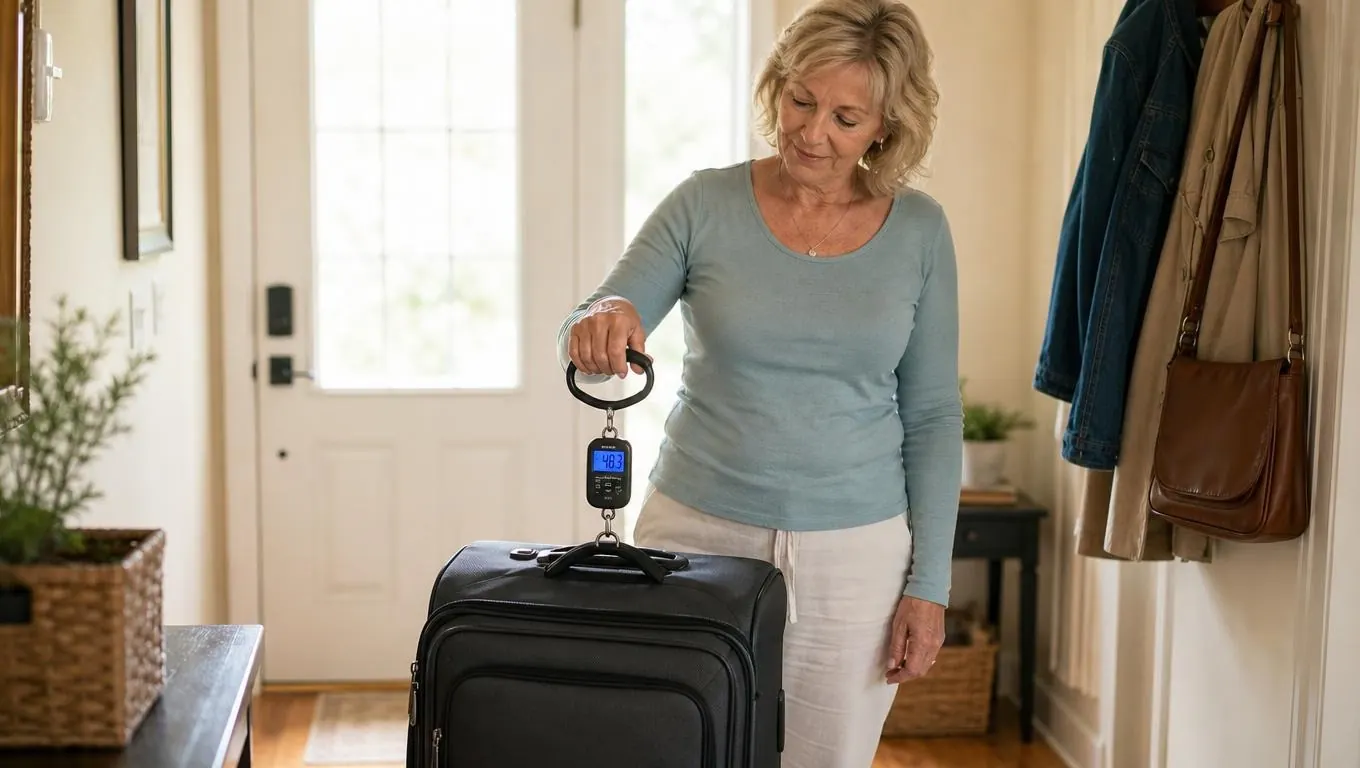
The fee is always the same story. You stand at the check-in counter, the agent asks you to put your bag on the scale, and the number comes up two pounds over. Then you pay, or you stand there unzipping your suitcase on the floor of a busy terminal, handing your husband your heaviest pair of shoes to carry onto the plane. I have been that person more times than I care to count, and the last time it happened, at the counter on the way to see Dale's brother in Arizona, I decided the fix was simple: weigh the bag at home before we ever left the driveway. The Etekcity Luggage Scale is the tool I use now, and it has saved us from overweight fees on every trip since. It is a small thing, but it makes the start of a trip feel smoother.
A luggage scale does exactly one thing: you loop its strap through the handle of your suitcase, clip it back to the scale, lift, and it tells you what the bag weighs. The Etekcity scale weighs up to 110 pounds, switches between pounds and kilograms with one button, and is small enough to live in the side pocket of my suitcase. I am not a gadget person, but this one earns its place because it removes a guess right before a deadline. This guide walks you through the whole process, step by step, so you can do the same before your next flight.
Know your bag's weight before the airline does
The Etekcity Luggage Scale straps to any suitcase handle, weighs up to 110 pounds, and fits in the palm of your hand. Check today's price on Amazon and start every trip without the check-in counter surprise.
Amazon Check Today's Price on Amazon →Step 1: Know your airline's limit before you pack
Every airline has its own checked bag limit, and the number is not always 50 pounds. Some carriers allow 50, some allow 70 for certain fares, and budget airlines sometimes drop the limit to 40. The limit also changes depending on the route and the ticket type you bought. On one trip to see Dale's brother in Arizona, the limit on the way out was 50 pounds. On the way back, our ticket was on a different airline with a 40-pound limit, and I had not checked before I packed. That mistake would have cost us.
Do not rely on what the limit was the last time you flew. Airlines change these numbers, and the agent at the counter has to follow the current rule, not the one you remember. A quick check takes two minutes and tells you exactly what number you are aiming for. I write the number on a sticky note and put it on the inside of my suitcase lid, so I cannot miss it while I pack.
Also check the carry-on limit if you plan to bring one. Most airlines allow one carry-on and one personal item, but the weight limit for carry-ons varies too, especially on international flights. Knowing both numbers before you pack saves you from making two mistakes instead of one. On our flight to Ireland last spring, the carry-on limit was 22 pounds, and my purse alone weighed almost four. I needed to know that before I started filling the bag.
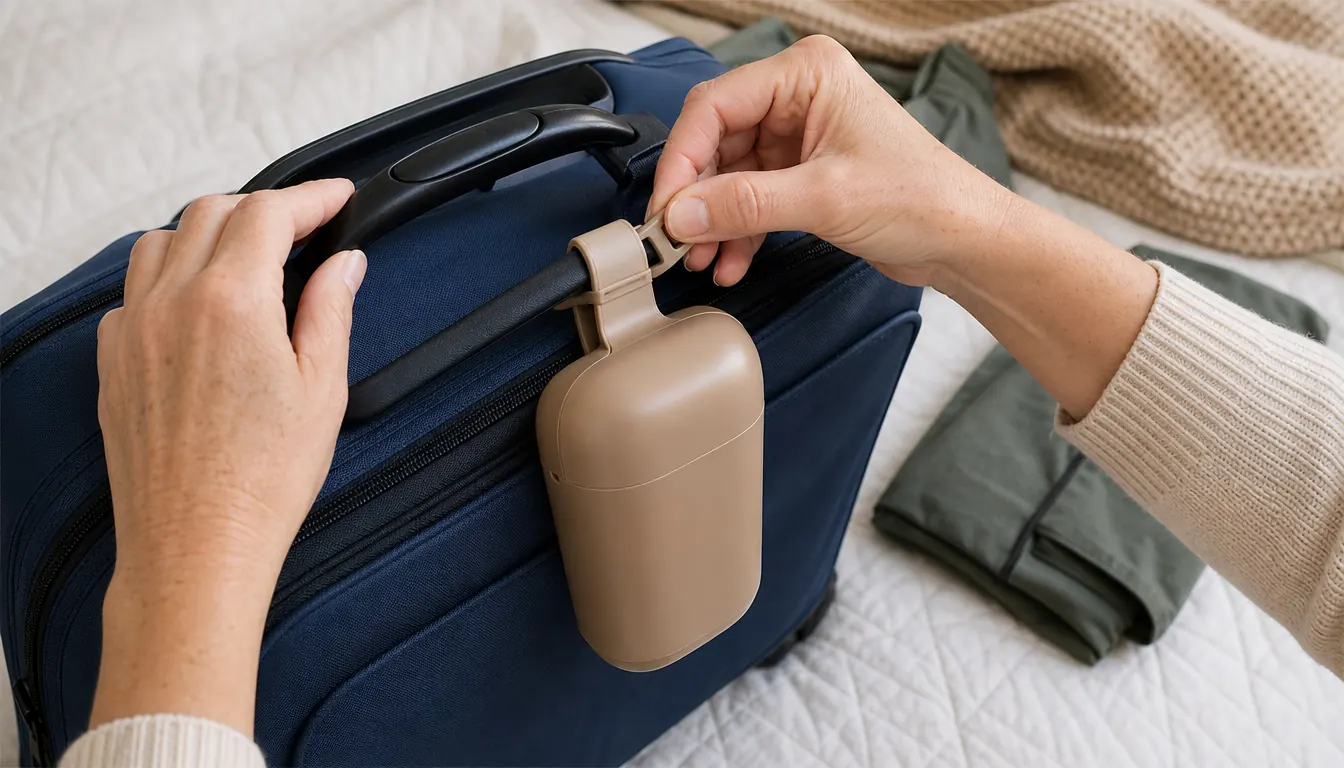
Step 2: Weigh the empty suitcase first
The suitcase itself weighs something, and that weight counts toward the limit. A large hard-sided case can weigh ten pounds or more before you put a single sock in it. Our big suitcase weighs nine and a half pounds empty, which surprised me because it feels lighter than that when I lift it by the handle. That leaves just over 40 pounds for the contents if the limit is 50. Weigh the empty bag first so you know exactly how much room you have for your stuff.
To weigh any suitcase with the Etekcity scale, loop the scale's strap through the top handle, clip it back onto the scale's hook, lift the bag a few inches off the floor, and hold it steady until the display locks. I have learned to wait until the reading stops changing, because the number can jump around for a moment when the bag swings. The scale shows the weight in pounds or kilograms, and you can switch between the two with a button on the front. Write down the empty weight, then subtract it from the airline's limit. That number is your packing budget.
If the empty suitcase alone puts you close to the limit, that is useful information before you pack, not after. You might decide to switch to a lighter bag or plan to wear your heaviest shoes on the plane. I have a smaller carry-on that weighs almost nothing, so if I am flying on a strict airline, I use that one instead. I also weigh the carry-on at the same time, even if the airline does not ask for a weight, so I know where I stand before I get to the gate. Knowing the empty weight first makes every later decision easier.
Step 3: Pack, then weigh the full bag
Pack the bag the way you normally would, then weigh it the same way you weighed the empty one. Strap the scale to the handle, lift, and wait for the number to settle. I set the scale to pounds before I start, using the button on the front, and I double-check the unit when I see the number because it is easy to read kilograms by mistake. The Etekcity scale has a small display that locks onto the weight after a second or two, so you do not need to hold the bag perfectly still for long. On the next Arizona trip, the first one after I bought the scale, my fully packed bag came to 53.2 pounds. That was 3.2 pounds over the limit, and I caught it in my hallway instead of at the counter.
Weigh the bag on a flat surface, not on the bed. A soft mattress lets the bag sink, which can throw off the reading. I put the suitcase on the floor in the hallway, lift it straight up, and let it hang for a moment. The scale measures the force of the bag pulling down, so the bag needs to hang freely for the most accurate number. I weigh the bag twice, from two different sides, to make sure I get the same number each time. If you can, have someone read the display while you hold the bag, or lift it high enough to see the screen yourself.
If the number is under the limit, you are done. If it is over, do not panic. You have options, and the next step is about fixing the problem while you are still at home, where fixing it is free. At the airport, fixing it costs money or involves repacking on a dirty floor. At home, you can take your time and do it right.
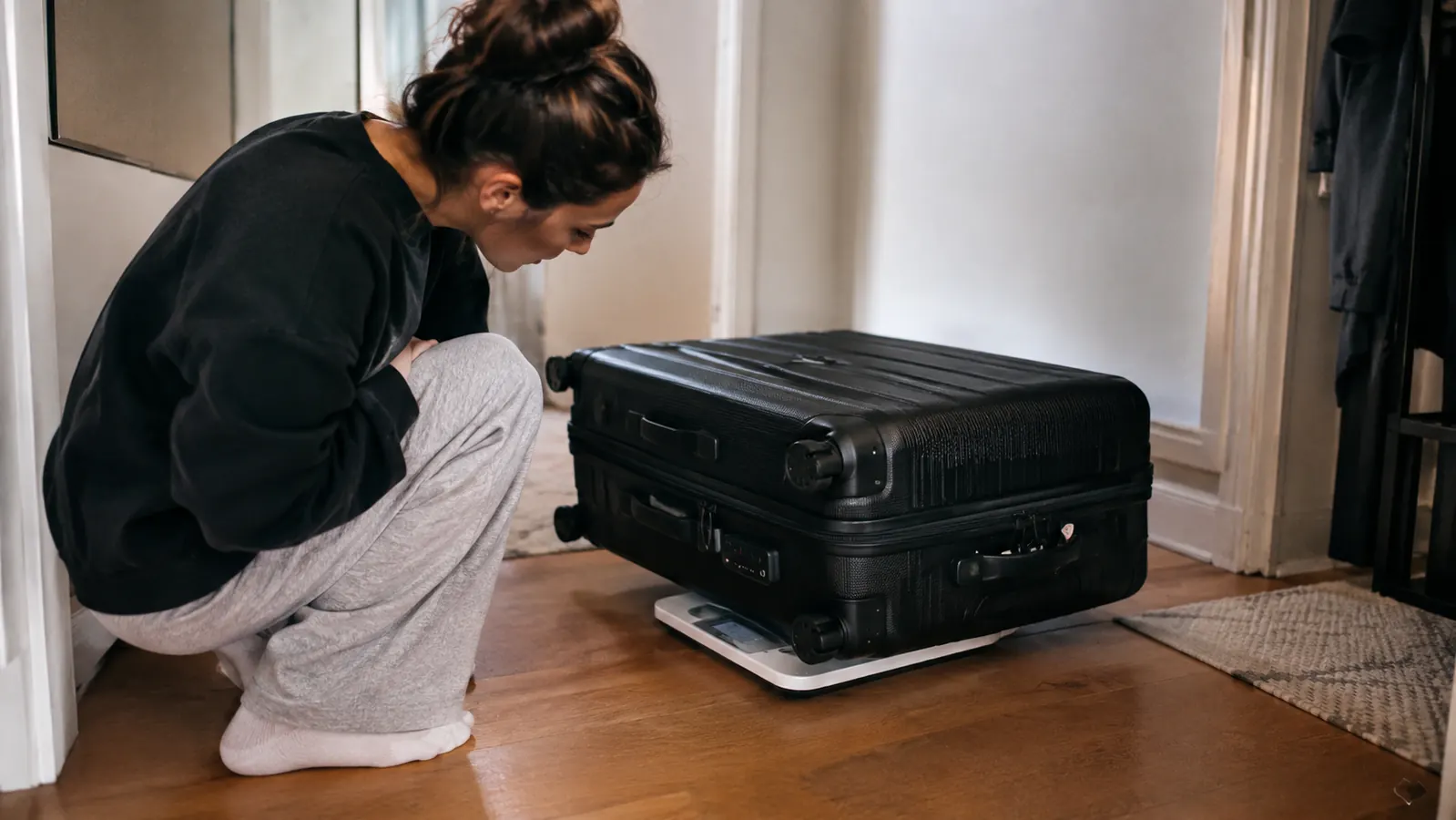
Step 4: Repack before you leave, not at the airport
The whole point of weighing at home is that you can fix an overweight bag before it costs you money. If the scale says you are four pounds over, open the bag and take out the four heaviest things you do not truly need. For me, that usually means the extra pair of shoes, the paperback I already finished, and the toiletry bottle that is still three quarters full. The trick is to take out the things that are heavy but not essential. A pair of sneakers can weigh two pounds. A hardcover book is another two. Smaller items add up faster than you think. On the Arizona trip, I pulled out my old sneakers, a thick sweatshirt, and a bottle of shampoo. That got me under the limit without giving up anything I actually used.
Wear your heaviest items on the plane instead of packing them. Dale wears his hiking boots when we fly, and I wear my bulkiest sweater. Dale grumbled the first time I made him wear his boots through security, but he stopped complaining when he saw the fee we avoided. It sounds silly, but it frees up real weight in the bag, and nobody at the gate has ever asked us to take them off. He also wears his heavier jacket in the terminal, even if it is warm outside, because it is easier to carry it than to squeeze it into an already tight suitcase.
Move heavy items from your checked bag to your carry-on if your carry-on has room and your airline allows it. Just remember that the carry-on has its own limit, so weigh that one too. The goal is to spread the weight across your bags so nothing is over its limit. Try to put the heavy carry-on items in a bag that fits under the seat in front of you, so you do not have to lift them into the overhead bin. On one trip, I moved two books and a pair of sandals from my checked bag to my carry-on, which dropped the big bag by two and a half pounds and kept the carry-on well under its limit.
Step 5: Weigh again, and keep the scale handy for the return trip
After you repack, weigh the bag one more time to confirm it is under the limit. I always leave a two-pound cushion, because the scale at the airport can read slightly differently from the one at home, and because I usually buy a few things on the trip that end up in the bag on the way back. That cushion has saved me more than once, because the scale in my hallway and the one at the airport have read the same bag differently by as much as a pound. If my airline allows 50 pounds, I aim for 48 or less.
Keep the scale in an outside pocket of your suitcase for the return flight. Souvenirs, gifts, and that bottle of local hot sauce all add weight, and the bag that was fine on the way out can be over on the way home. Weighing it in the hotel room the night before you fly gives you time to rearrange or leave something behind. On our Ireland trip, I weighed my bag at our guesthouse the night before we flew home and found it was 51 pounds. I unwrapped a few gifts and put them in my carry-on, and it came down to just over twenty-two kilos.
The Etekcity scale is small enough to slip into a side pocket, and it runs on one small battery that lasts a long time. I have had mine for about a year and I have never had to change it. It is one of those things that takes up almost no space and saves you from a very expensive surprise. I keep it in the same outside pocket as my packing cubes, so I never have to hunt for it.
What Else Helps
A luggage scale is the main tool, but a few other habits make the whole process easier. Use packing cubes to compress your clothes and keep the bag organized, so you can find the heavy items quickly when you need to pull them out. Keep a small digital bathroom scale in your closet for weighing things like shoes and toiletries before you decide whether to pack them. And if you travel with a partner, weigh both bags, not just yours. On our last trip, my bag was two pounds under and Dale's was three pounds over. We swapped a few items between bags, and both made the flight without a fee.
Another habit is to weigh the bag again at the airport if you have time. Some airports have a scale near the check-in line, or you can find the baggage service office and ask. It is not worth paying a fee to check a bag that might be fine. Weighing at home first means you rarely need to do this, but it is a good backup on a long trip.
If you are not sure your scale is accurate, weigh something you know the weight of, like a five-pound bag of flour from the pantry. The Etekcity scale should show close to five pounds. I tested mine this way when I first bought it, and it has been consistent ever since. It is a five-minute check that keeps you from trusting a bad reading at the worst time. And if your limit is 50 pounds, keep your toiletries in a small clear bag and put them in the outer pocket so you can pull them out easily if you need to remove something at the curb.
The scale at the airport can read slightly differently from the one at home, so I always leave a two-pound cushion.
Skip the check-in counter surprise
The Etekcity Luggage Scale weighs up to 110 pounds, fits in your suitcase pocket, and pays for itself the first time it saves you from an overweight fee. Check today's price on Amazon and pack with confidence.
Amazon Check Today's Price on Amazon →