
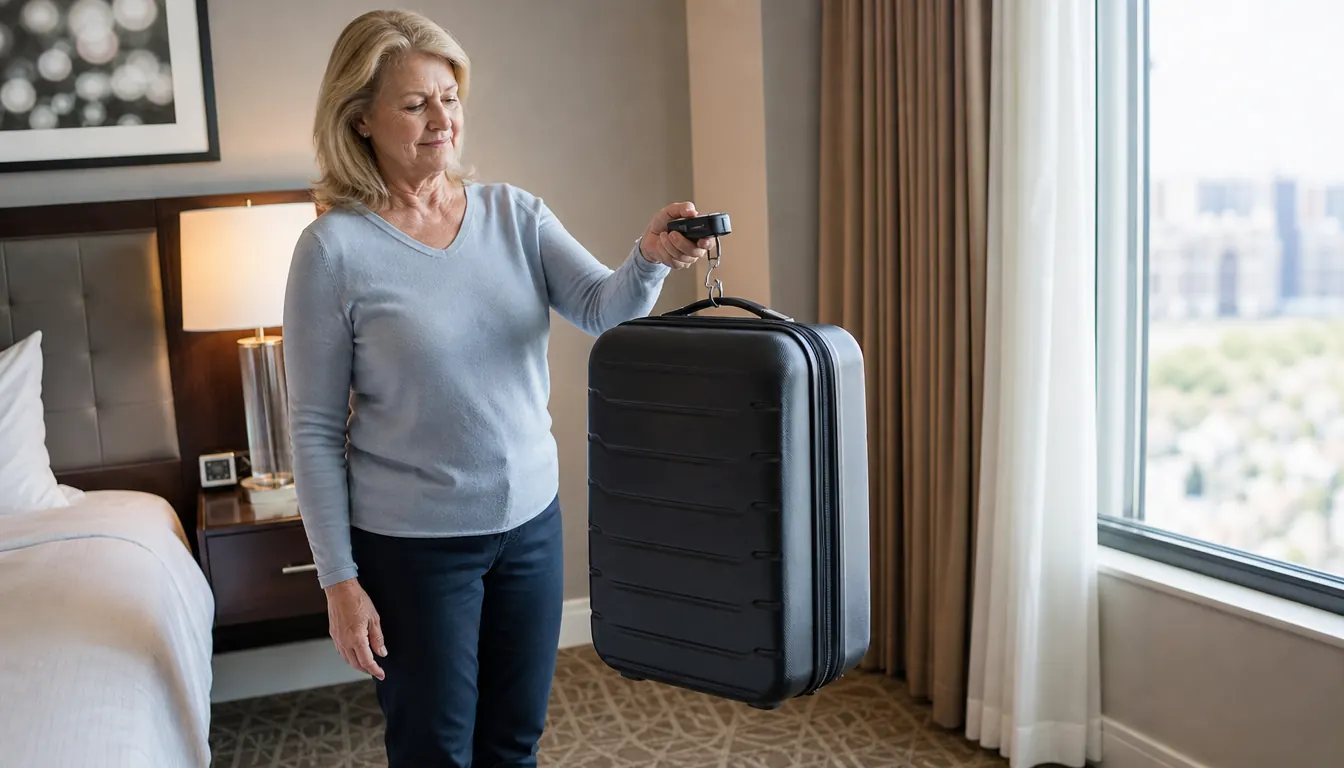
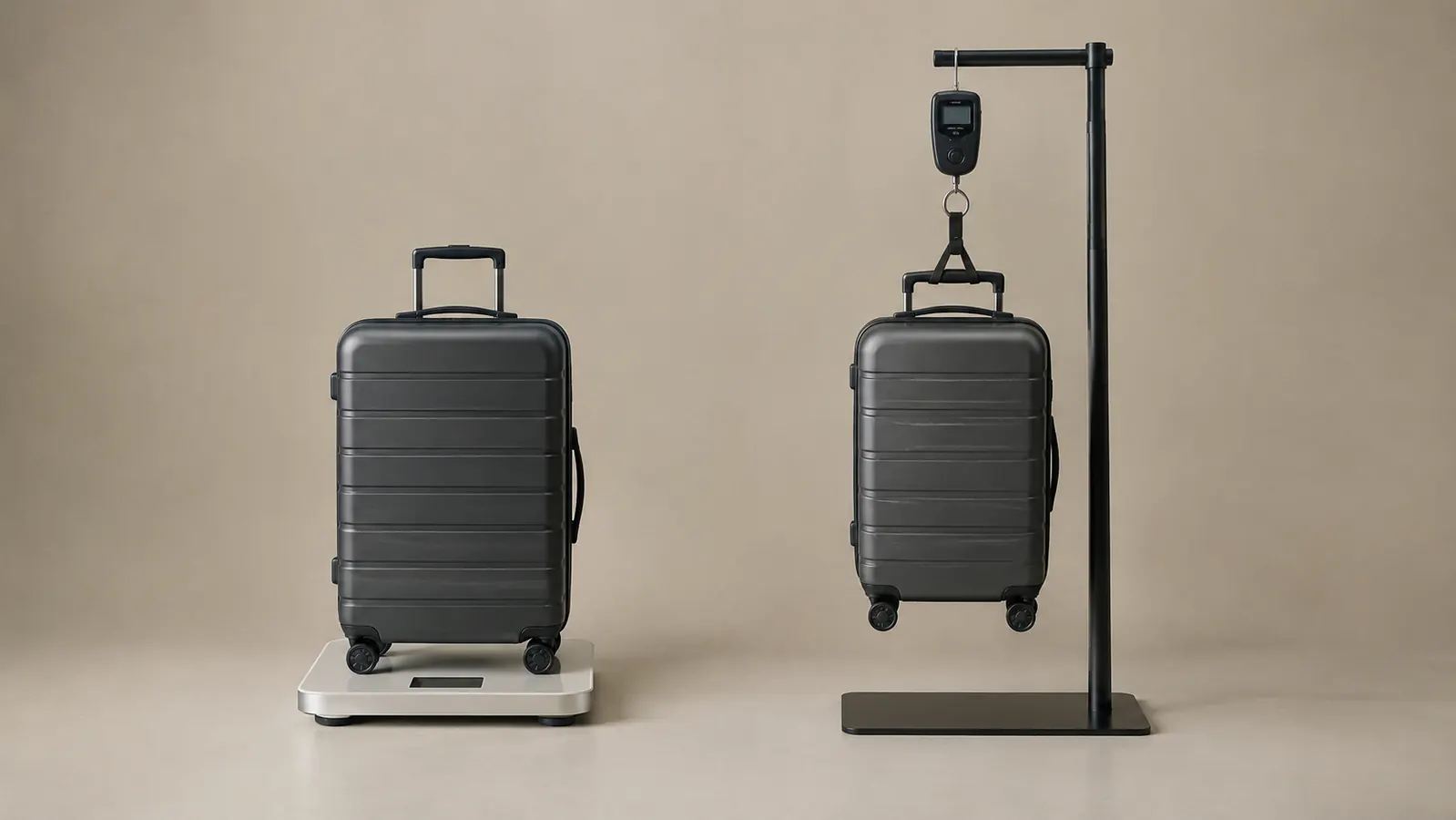
For years I weighed my suitcase the way a lot of people do. I hauled it into the hallway, set the bathroom scale on the tile, weighed myself, then weighed myself again hugging the bag, and subtracted. Some years I tried balancing the suitcase on the scale by itself and reading the number past the handle while I held it upright with one knee. Either way I was never quite sure the number was right, and I found out the hard way that it was not. The Etekcity luggage scale replaced that routine, and after using both side by side, I wonder why I put up with the bathroom scale for so long.
The short answer: a hanging luggage scale like the Etekcity is easier, more consistent near the limit, kinder to your back, and it travels with you, which matters more than people think. The bathroom scale is free because you already own it, it handles odd shapes the Etekcity cannot, and for a bag that is obviously light, it is plenty. Here is the honest comparison, including the trip that cost me an overweight fee and the test I ran at home afterward.
| Etekcity Luggage Scale | Bathroom Scale | |
|---|---|---|
| Accuracy near the limit | Bag hangs freely, nothing rests on the floor | Depends on balance; a corner touching the floor or a bath mat throws it off |
| Ease of use | Strap through the handle and clipped back, lift a few inches, read the number | Weigh yourself, weigh yourself holding the bag, subtract |
| Back strain | Bag lifted a few inches, held for two or three seconds | Bag hugged against your chest while you stand still on the scale |
| Re-weighing after changes | Open, remove an item, weigh again in under a minute | Every re-weigh is another lift and another subtraction |
| Travels with you | Fits in a suitcase side pocket for the trip home | Stays home; most hotel rooms do not have one |
| Odd shapes with no handle | Needs a handle or something to loop the strap through | Weighs a box or a handle-less bundle fine |
| Cost | A small one-time purchase | You already own it |
| Best for | Checked bags flown a few times a year, packers who live near the limit | A quick check of an obviously light bag at home |
Where the Etekcity Luggage Scale Wins
The biggest difference is consistency right at the limit. When a bag hangs from the Etekcity scale, nothing touches the floor and nothing else takes part of the weight. With a bathroom scale, the bag either balances on top, where a corner can rest on the floor, or you hug it and subtract, which stacks two readings and two rounding errors on top of each other. If the scale is sitting on the bath mat instead of hard tile, it can read low, and you will never notice, because the number looks perfectly reasonable. Mine read three pounds lighter on the mat than on the tile with the same bag, which I only learned later, when I went looking for what had gone wrong.
What had gone wrong was a trip to see Dale's brother outside Phoenix last fall, before I owned a luggage scale. I had packed for five days, which for me means I packed for eight. At home, the bathroom scale method said 49 pounds. I was sure I had done it right: tile floor, zeroed scale, weigh myself, weigh myself with the bag, subtract. At the check-in counter, the airline scale said 53. The agent looked at the number, looked at me, and told me the fee. I paid it, and I spent the whole flight annoyed at myself. The bag had not gained weight between the hallway and the airport. My method had just never been as good as I thought.
The Etekcity scale is also easier on my back. I am 63, and my lower back complains after long sitting, so hugging a fifty-pound suitcase against my chest and standing perfectly still on a bathroom scale while I wait for the number to settle is exactly the kind of thing I try to avoid. With the Etekcity, I loop the strap through the handle, clip it back onto the scale's hook, bend my knees, and lift the bag a few inches with both hands. It locks the reading in two or three seconds, and I set it down. On a heavy bag, Dale does the lifting, and it takes him about as long as it takes me to say the number out loud.
The other place the Etekcity scale wins is when you have to adjust the bag. The next time we flew to Arizona, I brought it along, and on the morning we flew home, my bag was at fifty-one point two pounds. Souvenirs and a stack of paperback books from a used bookstore near his brother's place had done it. I opened the suitcase on the hotel bed, moved the books into Dale's bag, which had room, and weighed mine again: forty-eight and change. It took maybe four minutes. With the bathroom scale method, every re-weigh is another lift, another subtraction, and another chance to misread, and there was no bathroom scale in that hotel room anyway.
That points to a win I did not expect: the Etekcity scale goes where the problem is. Bags gain weight on the way home, not on the way out, and the way home starts in a hotel room, a guest room at a relative's house, or a cruise cabin. None of those come with a bathroom scale you would trust. The Etekcity lives in the mesh side pocket of my suitcase and weighs about as much as a deck of cards. It also made me pack better in the first place. When I know I will weigh the bag before we leave, I think twice about the second pair of boots and the extra jeans. The bathroom scale never gave me that moment, because the whole process was such a production that I did it once, right before we walked out the door, when it was too late to change much.
It also handles kilograms, which a bathroom scale at home rarely needs to. On our two weeks in Ireland, every limit we ran into was written in kilos, and the check-in agent on the way home asked for our bags in kilos too. I pressed the button, switched the Etekcity over, and had our numbers before we left the guesthouse: just over twenty-two kilos for my bag, a little under for Dale's. Doing that with the bathroom scale would have meant weighing at home in pounds before we left, converting, and then guessing on the way back, after a gift shop in Dingle and a wool sweater I absolutely did not need had gone in the bag. With the Etekcity, I knew exactly where we stood the night before the flight, sitting on the edge of the guesthouse bed.
Weigh your bag in seconds, not with a sore back
The Etekcity luggage scale straps through your suitcase handle, lifts clean off the floor and locks the reading in seconds. It rides in a side pocket, so it is there for the trip home too.
Amazon Check Today's Price on Amazon →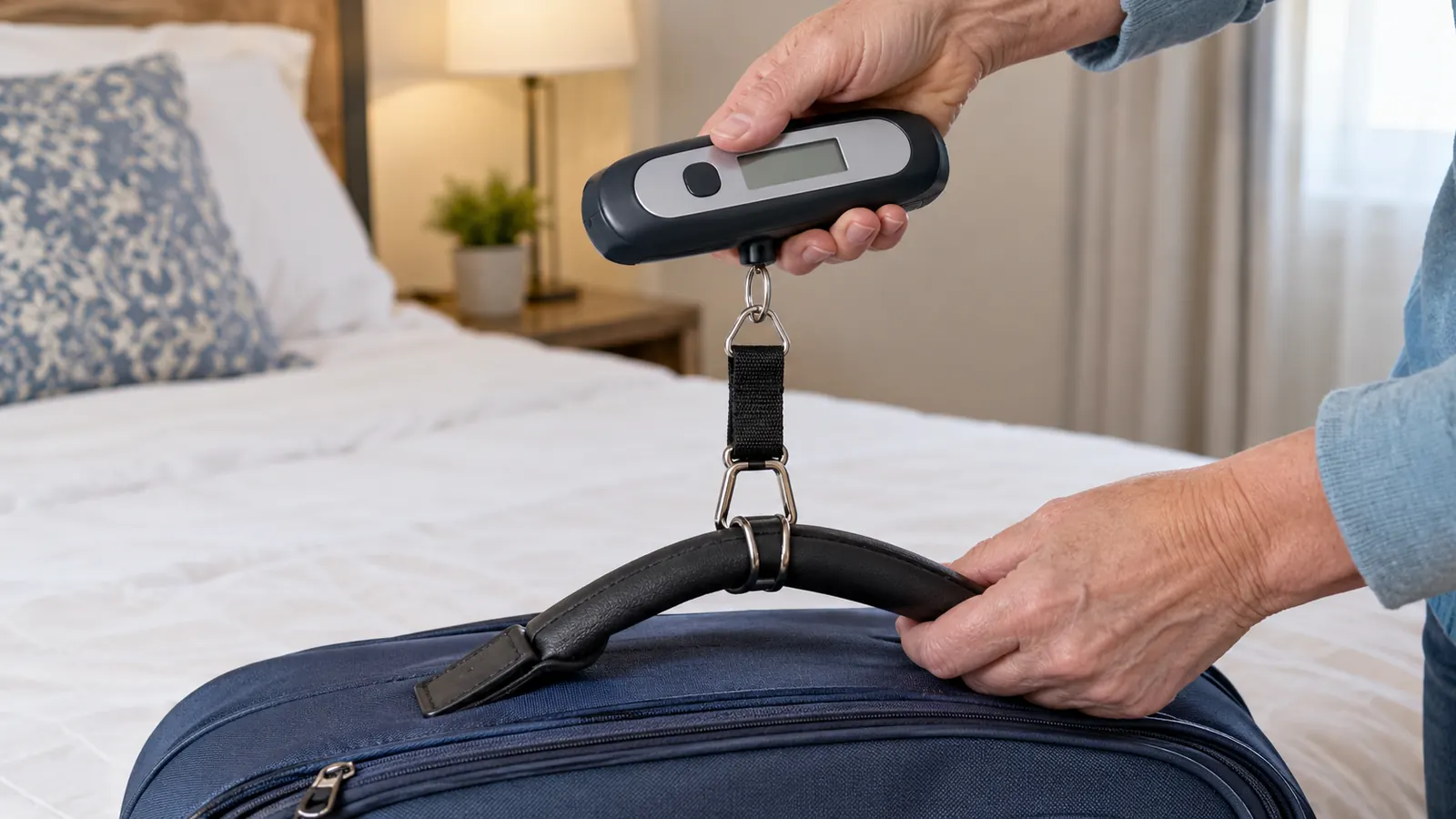
Where the Bathroom Scale Wins
I will be honest: the bathroom scale has a real advantage, and it is that you already own it. If you fly once a year and your bag is always well under the limit, you do not need to buy anything. The method works well enough when you are careful. Put the scale on a hard, flat floor, never a bath mat or carpet. Weigh yourself, then weigh yourself holding the bag, and subtract. Do it twice and see if you get the same number. If both tries agree and you are ten pounds under the limit, you are fine. A digital bathroom scale does this better than an old dial one, because you are not squinting down past a suitcase at a needle that is still swaying. Our old dial scale, the one that lived in the hall closet for twenty years, could not settle on the same number twice with me standing on it alone, never mind with a suitcase in my arms. If that is the scale you have, the luggage scale is a bigger step up than it would be over a newer digital one.
After the Phoenix fee, I ran a little test at home to see how far off the bathroom scale really was. I packed a suitcase, weighed it three times on the Etekcity, and got the same number all three times, within a few tenths of a pound. Then I weighed the same bag three times with the bathroom scale hug-and-subtract method on the tile. I got three different answers spread across about two pounds. Then I tried it on the bath mat and got a number three pounds light. So the bathroom scale is not useless. It just has a wider margin of error than you would want right at the line, and you cannot tell from a single reading which way it is off.
The bathroom scale also wins for things that cannot hang. One Christmas I mailed a cardboard box of wrapped presents to the grandkids, taped shut, no handle anywhere, and I wanted the weight before I got in line at the post office. The Etekcity scale needs a handle or something to loop the strap through, and I was not going to tie the box up like a parcel just to weigh it. I set it on the bathroom scale, it read the number, and that was that. Same goes for an oddly shaped bundle or a bag whose only handle is a flimsy loop you would not trust with fifty pounds hanging from it. For those, the bathroom scale is the better tool.
And there is one thing the bathroom scale does that the Etekcity never will: it weighs you. That sounds like a joke, but it is the reason this is not really an either-or choice. Our bathroom scale stays in the hallway, Dale steps on it every morning, and I step on it more often than I like to admit. The Etekcity scale is a travel tool, not a household one. The real question is whether to add a small travel tool to a house that already has a bathroom scale. For a bag that is obviously light, like a weekend tote, the bathroom scale tells you all you need. The trouble starts near the limit, which is exactly where most of my bags live. A bathroom scale can tell me a bag is somewhere around 48 to 52 pounds. The Etekcity tells me it is 50.4, and when the limit is 50, that difference decides whether I open the suitcase at home or at the counter.
Who Should Buy Which
Buy the Etekcity luggage scale if you fly with checked bags a few times a year, if you tend to overpack, or if you have ever stood at the check-in counter holding your breath while the agent read the number. It is the better choice if you have back trouble, because you only lift the bag a few inches for a couple of seconds. And it is the only one of the two you can bring along, which matters because the bag that gets you in trouble is usually the one coming home, full of souvenirs and books you swore you would not buy.
There is a middle case worth a word. Some airlines, especially smaller carriers and short flights overseas, weigh carry-ons too, and the limit can be well under what most people pack. We are mostly carry-on travelers, and on a short hop during the Ireland trip, the posted carry-on limit was low enough that I weighed both our carry-ons the night before, something I would never have bothered to do with the bathroom scale routine. Mine was fine. Dale's, with his hardback book, his tablet and a bag of snacks, was right at the line. He moved the snacks into his jacket pockets and was fine too. If you fly carry-on only, check whether your airline weighs carry-ons. If it does, the Etekcity earns its pocket space even when you never check a bag.
Stick with the bathroom scale if you rarely fly, if your bag is always well under the limit, or if what you are weighing is a box or a bundle with nothing to hang it from. There is no reason to buy a tool you will not use. If you go that way, put the scale on hard tile, weigh twice, and leave yourself a few pounds of cushion to cover the margin of error. But if you have ever been surprised at the airport, or you pack the way I do, the Etekcity scale is the one that tells you the truth while there is still time to do something about it.
Stop guessing at the check-in counter
The Etekcity luggage scale fits in a suitcase pocket and gives the same reading every time you lift the same bag. Weigh it at home, weigh it again before the flight back, and fix the problem on the hotel bed instead of at the counter.
Amazon Check Today's Price on Amazon →