
Overweight bag fees have crept up at nearly every airline, and I have watched more than one person at the check-in counter open a suitcase on the floor and start pulling out sweaters while the line behind them grows. I decided I did not want to be that person, and then on the way to see Dale's brother in Arizona I very nearly was: the agent's scale read over the limit, and I paid the overweight-bag fee right there at the counter. I ordered the Etekcity luggage scale the week we got home. About a year and a few dozen weigh-ins later, I can tell you exactly what it does well, where it falls short, and whether it deserves the space in your bag.
I am Bev, a retired school bus dispatcher from Knoxville, and Dale and I travel a few times a year. I am not a travel writer by trade. I bought this scale myself, used it on real trips, and kept using it long after the return window closed. Dale and I are mostly carry-on people, but we check bags for the long trips, and the long trips are exactly where the weight creeps up on you. This is the long-term review I wish I had found before I bought it.
The Quick Verdict
The Etekcity luggage scale takes the guesswork out of packing and has caught more than one overweight bag in my bedroom instead of at the counter. It is not perfect, but it is the first thing I pack for any trip with a checked bag.
Amazon Check Today's Price →Stop Guessing What Your Suitcase Weighs
The Etekcity luggage scale weighs up to 110 pounds, reads in pounds or kilograms, and fits in a suitcase side pocket. Mine has come on every trip for about a year.
Amazon Check Today's Price on Amazon →How I've Used It
I have used this scale on every trip for about a year. That includes the next flight to Phoenix to see Dale's brother, our January cruise out of Florida, two drives to North Carolina where I weighed bags just for practice, and our two weeks in Ireland last spring. On every trip where a bag got checked, I weighed it the night before, and on the longer trips I weighed it again in the hotel room the morning we flew home, because the trip home is where the souvenirs live.
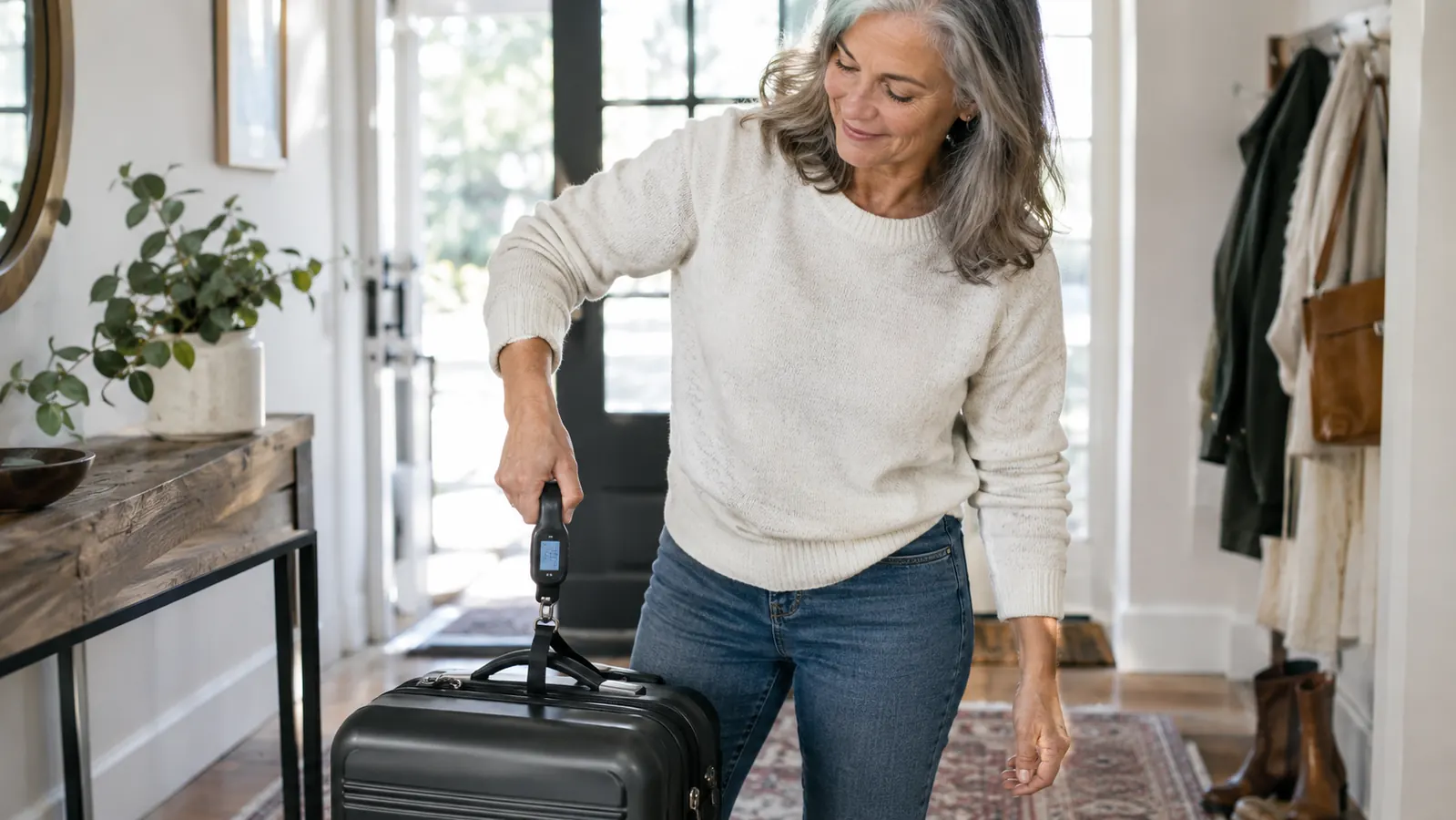
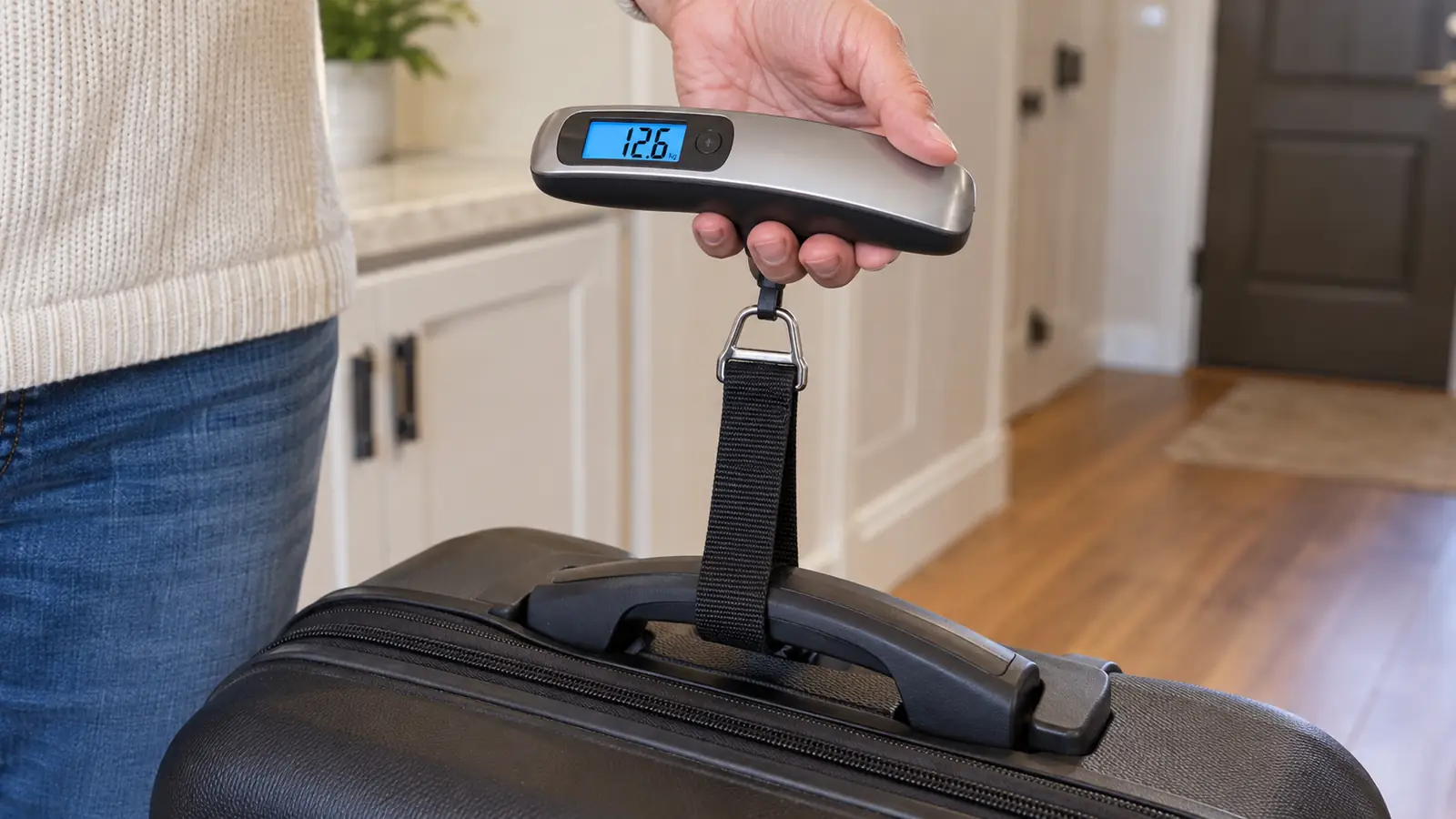
The routine is simple. I pack the suitcase and zip it. I loop the scale's nylon strap through the top handle, clip it back onto the scale's hook, and lift the scale slowly with both hands until the bag clears the floor by a few inches. I hold it there for two or three seconds, the display locks the number, and I set the bag down. I write the number on a sticky note and put it on the handle. If it is over, I have time to move things around or leave something home, all while I am still in my bedroom instead of at the counter.
The scale earned its keep on the flight down to Florida for our cruise. We each checked a bag because of formal nights and Dale's insistence on two pairs of dress shoes, and the night before, the scale showed my bag at fifty-four pounds against a fifty-pound limit. I moved my toiletry bag and a pair of sandals into my carry-on, swapped a heavy cardigan for the one I would wear on the plane, and got it down to forty-eight. At the airport the next morning, the agent's scale said forty-eight point four. I did not have to open anything on the floor, and that is the whole reason I bought it.
The first time I used it, I did it wrong. I was in a hurry, I clipped the strap only partway onto the hook, and I jerked the bag up with one hand like I was lifting a bucket of water. The reading bounced between three numbers and then locked on one I did not trust, and the strap slid sideways on the handle. Dale watched from the doorway and suggested I try it like a person who was not late for something. The fix: strap clipped all the way onto the hook, lying flat and centered on the handle, lift slowly with both hands, elbows bent, and let the bag hang still for a couple of seconds. After that, the readings locked in clean and repeated within a few tenths of a pound if I weighed the same bag twice.
What the Etekcity Luggage Scale Gets Right
The first thing I noticed was how simple it is. You press the button to turn it on, you can switch between pounds and kilograms, and the strap and hook do the rest. The display is easy to read without my reading glasses, which matters more than I expected. The digits are big and clear, and once the reading locks, it holds the number after you set the bag down, so I am not trying to read a screen while holding fifty pounds at arm's length.
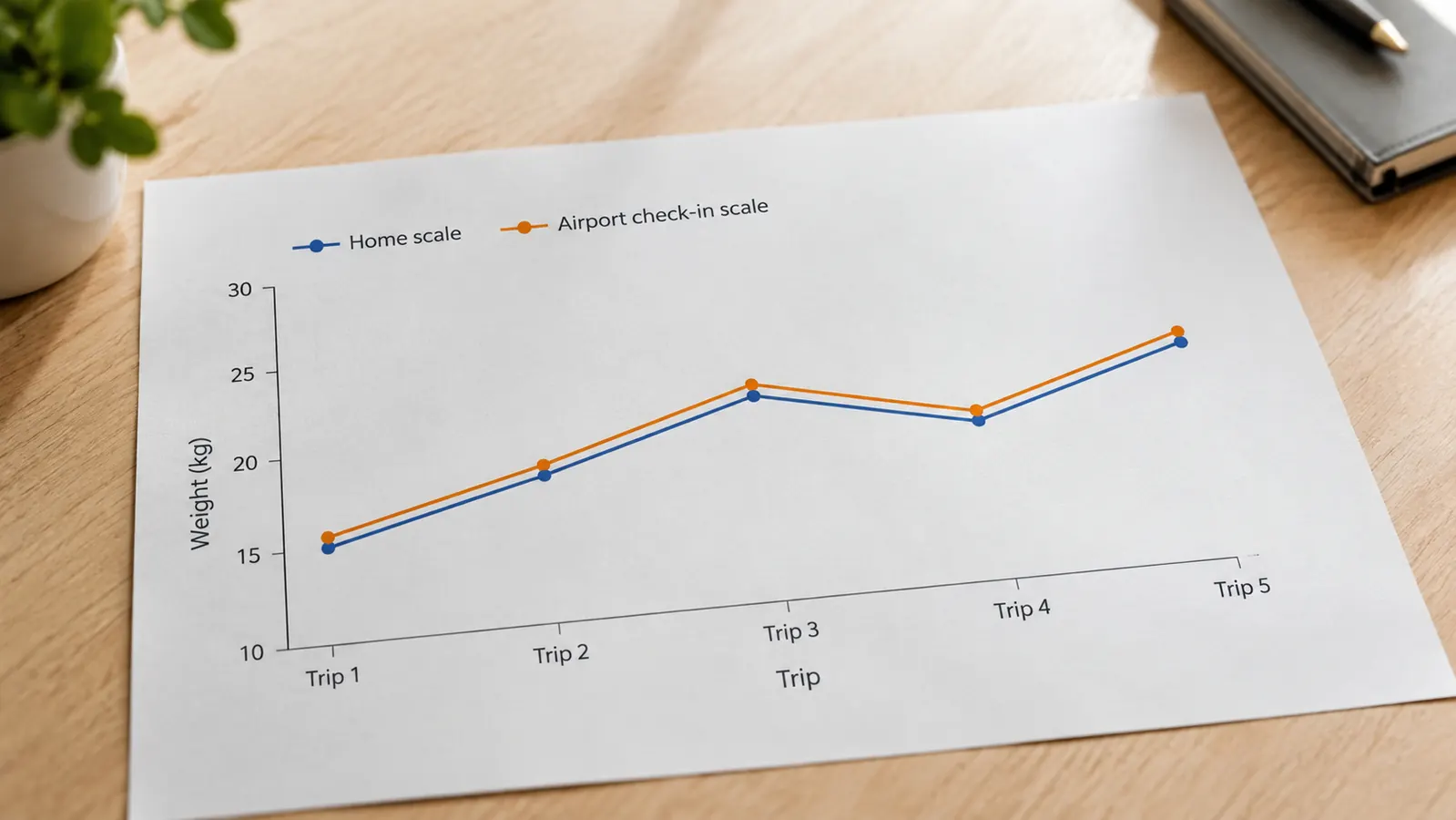
Accuracy is the reason anyone buys a luggage scale, so this is the part I paid the most attention to. I compared my readings to the airport check-in scale on five different flights, writing down both numbers in the notes app on my phone. The Etekcity scale was within half a pound every time, and on three of those flights it matched the airport scale exactly. At home, I also hung a twenty-pound bag of rice and a full ten-pound sack of potatoes from it, and it read both within a few tenths. That is close enough for me, because I always leave a two-pound cushion under the limit anyway.
The scale handles up to 110 pounds, which covers every suitcase I own with plenty to spare. It reads to a fraction of a pound, so I can see exactly how much room I have left before I add the last pair of shoes. The strap is about an inch wide and has held up through a year of lifting bags that weigh more than they should. I check it for stretching or fraying before every long trip and have not seen any.
The pound and kilogram switch has come in handy more than once. In Ireland, every scale we ran into, at the airport and at the little guesthouse where the owner kindly let me weigh our bags on hers, read in kilograms. Instead of doing mental math at the front desk, I switched the Etekcity scale over and knew we were at twenty-two kilos with room to spare. On the flight home, the check-in agent mentioned the limit in kilograms, and I already had our numbers. It is a small thing, but it is the kind of small thing that makes a gadget feel thought out.
How It Holds Up Over Time
After about a year of regular use, the scale still wakes up the moment I press the button and gives the same readings it did on day one. I tested that the boring way: the same bag of rice, weighed in the first week and again a year later, read the same both times. I have dropped it once on a tile hotel bathroom floor, and it survived without any change in accuracy. The plastic body has a few scuffs now, but nothing that affects how it works.
The battery is the part I was most worried about, because I have owned plenty of small gadgets that died after a few months. The Etekcity scale runs on one small battery that came installed, and after a year of trips and a year of sitting in my suitcase pocket between them, it is still on the original. I know a spare is cheap and tiny, so I tucked one into my toiletry bag, because the one thing worse than an overweight bag is a scale that dies the night before a flight.
One thing I will say honestly: the scale is not built like a piece of luggage. It is a small plastic gadget, and it feels like one. That is fine for what it is, but I would not toss it loose into the bottom of a bag under a pair of walking shoes and a hair dryer. I keep mine in the mesh side pocket of my suitcase with the strap wrapped snugly around the body, so the hook cannot snag a sweater and the button cannot get pressed by accident on the way to the airport. In a year, that pocket has kept it in one piece.
The auto-off feature has been a quiet blessing. The scale shuts itself off after about a minute of sitting still, so I have never once found it dead in my suitcase because I forgot to press the off button. I am the person who leaves the garage door opener in the car and the basement light on for three days, so a gadget that manages its own power is exactly the kind I need.
On five flights, the Etekcity scale matched the airport check-in scale within half a pound every time, and three times it matched exactly.
Where It Falls Short
The biggest limitation is that you have to lift the suitcase yourself. If you have a bad back, a very heavy bag, or stiff hands, this scale may be hard to use. My lower back complains after long sitting, so I lift with my knees, keep my elbows bent and the bag close, and only hold it up for the two or three seconds it takes to lock a reading. Dale, who spent nearly forty years as an HVAC technician carrying equipment up attic ladders, does the lifting when a bag is pushing fifty pounds, and he does not mind telling me how many sweaters I packed.
The hook is also on the small side. It works with the strap, which is how it is meant to be used, but if you try to hook it straight onto a suitcase handle, it will not fit most of them. On my largest suitcase, which has a thick padded handle, the strap is snug and I have to position the strap flat across the top of the handle rather than bunched underneath, or it twists and the reading wanders. On a soft duffel, I pull the strap snug and check the clip twice. None of it is hard, but it took a few tries to learn.
It only weighs, and it does not know your airline. The scale will tell you fifty-one pounds, but it will not tell you whether your fare allows fifty, or whether the regional carrier on your connection allows less. On our Ireland trip, the limit on the outbound flight and the limit on a short hop we took were different, and I only caught that because I looked it up the night before. The scale gives you a number. You still have to know what number you are aiming for, and that means reading the fine print on your own ticket.
The other thing I noticed is that the scale needs a still moment to give its best reading. If the bag swings, or the strap is not centered on the handle, the number can wobble for a second before it locks. In a cramped cruise cabin I had to weigh a bag in the narrow space between the bed and the closet, and the suitcase kept bumping the bed frame, which threw the reading off by a pound until I moved into the doorway. It is not a flaw so much as a reminder that this is a tool with a technique. Once I learned to give it clear space and hold still for two seconds, the wobble stopped mattering.
What I Liked
- Matched the airport check-in scale within half a pound on five flights, exactly on three
- Easy-to-read display that holds the reading after you set the bag down
- Switches between pounds and kilograms, handy on international trips
- Handles up to 110 pounds, more than any suitcase I own
- Original battery still going after about a year, with auto-off
- Small enough to live in a suitcase side pocket
Where It Falls Short
- You have to lift the bag yourself, which is hard on a bad back
- The hook is small and only works through the strap, not on a handle directly
- Thick padded handles need the strap positioned carefully or it twists
- Plastic body feels light and should not ride loose under shoes
- It weighs, but it cannot tell you your fare's weight limit
Who This Is For
This scale is for anyone who has ever stood at an airport check-in counter with their heart beating a little faster while the agent puts the bag on the scale. It is for the person who packs the night before and wants to fix a problem while there is still time to fix it. It is for the couple that argues about whether the bag is too heavy, because now you have a number instead of an argument.
It is also for people who check bags on cruises, people who fly airlines with strict 50-pound limits, and people who travel with gifts or souvenirs that magically add weight on the way home. If you have ever had to open your suitcase on the airport floor and decide which shoes to leave behind, this scale is for you.
Who Should Skip It
Skip it if you only travel with a small carry-on that you can lift with one hand, or if you never check a bag and your airline does not weigh carry-ons at the gate. Skip it if you have a back problem and no one to help you lift, because this scale requires you to hoist the bag yourself, and if lifting is hard on you, ask your doctor before you start heaving suitcases around. And skip it if you need laboratory precision to the ounce, because this is a travel gadget, not a shipping scale.
For everyone else, the Etekcity luggage scale is one of those rare purchases that does exactly what it says. It has kept me from opening my suitcase on an airport floor, settled more than one discussion with Dale about whose bag is the heavy one, and made the night before a flight a little calmer. I pack it first, and I expect to keep packing it for a long time.
Pack It First, Worry Less
A year of weigh-ins and not one surprise at the counter. The Etekcity luggage scale is small, it matched the airport scale within half a pound on every flight I checked, and it lives in my suitcase pocket.
Amazon Check Today's Price on Amazon →