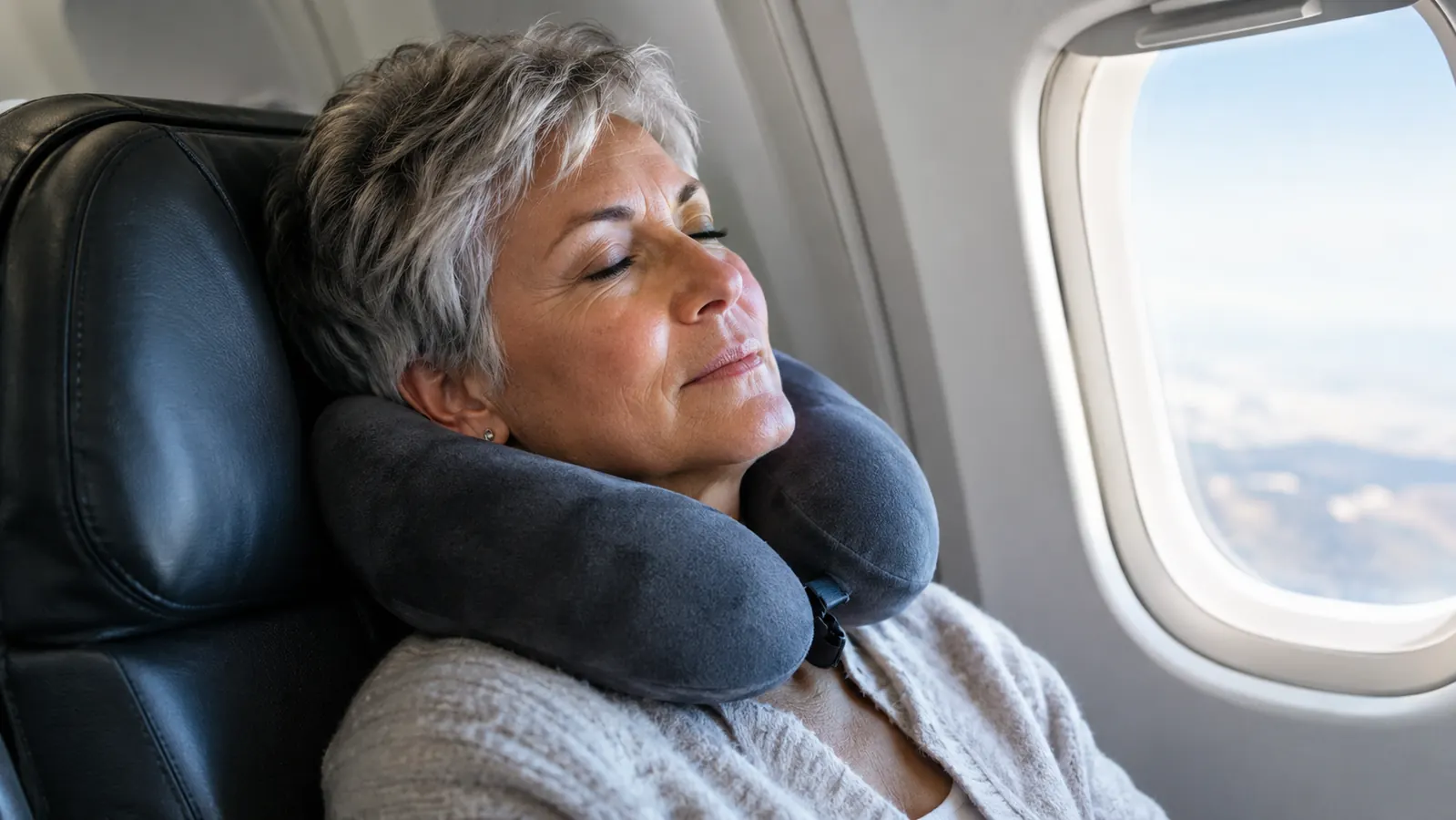
I have a confession to make. For years I was an inflatable pillow person. It rolled up smaller than a pair of socks, lived in the pocket of my carry-on, and I never had to think about it. Then Dale and I flew out to Phoenix to see his brother on a 6:40 a.m. flight with a connection, and I spent most of the day with my head listing toward the window like a sunflower that forgot where the sun was. The napfun Neck Pillow I ordered after we got home changed my mind on our next flight out there, and I have been weighing which one actually deserves space in my bag ever since.
This is not a comparison that pretends one pillow is right for everyone. I carried an inflatable on that flight out to Arizona and the napfun memory foam pillow on the next one, then we drove to North Carolina with both in the back seat to see which one I reached for. The short answer: the napfun wins on comfort, staying put and lasting, and the inflatable wins on size, adjustability and how little it asks of you up front. Details below.
My verdict: The napfun memory foam pillow wins for comfort, staying put and durability. The inflatable wins for packing size, adjustable firmness and up-front cost. If you fly more than twice a year, the napfun is worth the pocket it takes. If you need a pillow for one flight a year and hate extra bulk, the inflatable is still a reasonable choice.
The pillow I now pack for every flight over two hours
After an early flight that left me stiff for two days, I switched to the napfun memory foam pillow for our next trip out. It takes more room than an inflatable, but it holds my head up for the whole flight instead of slowly going soft.
Amazon Check Today's Price on Amazon →How I Compared Them
I tested both pillows on the same route to Phoenix. The first flight left at 6:40 in the morning with a connection, and I used the inflatable because it was the one I owned. I ordered the napfun after we got home, and on our next flight out to see Dale's brother I used it instead. Same airline, same size seats, same tired me. Later on, I spent a few hours in the passenger seat on the way to North Carolina with both pillows in the back seat, and I switched between them at a rest stop to see which one I preferred when I was awake and reading, not just sleeping.
I judged them on five things: comfort while sleeping, how much space they took in my carry-on, how easy they were to set up, how they held up over time, and whether I would actually want to carry them through an airport. I kept notes in my phone, which Dale found hilarious, but it meant I did not have to rely on memory a week later. For each flight I wrote down roughly how long I slept in one stretch, how my neck felt when we landed and again that evening, and how many times I had to fuss with the pillow. Those last two numbers ended up telling me more than anything else. A pillow you adjust six times an hour is not a pillow you are sleeping on.
The inflatable I used was a plain blue one I had bought a couple of years earlier for a cruise out of Florida. It had already survived one slow leak, which I patched with a dab of glue and a lot of hope. The napfun pillow arrived well before our next Phoenix trip, so I had time to wear it at home first, sitting up on the couch in the evenings. That turned out to matter, because it took me a few tries to work out which way it sat best on my neck, and I wanted to know that before I was stuck in seat 14B with a pillow I did not understand.
| napfun Neck Pillow | Inflatable Travel Pillow | |
|---|---|---|
| Comfort over hours | Memory foam holds the head and neck, stays supportive for the whole flight | Firm when fully inflated, softens as air seeps out |
| Packing size | Needs a carry-on pocket or a spot on top of the bag | Rolls down to the size of a pair of socks |
| Setup | None, take it out and put it on (give it time to expand first) | 10 to 15 breaths to inflate, then close the valve |
| Adjustable firmness | Fixed shape and firmness | Add or let out air to suit your neck |
| Stays in place | Holds its shape and stays where you put it | Tends to slide forward on the headrest |
| Durability | No seams or valves to fail, same shape after months | Slow leaks at seams and valves over time |
| Cleaning | Cover zips off and goes in the wash | Wipe down only on most, the fabric flocking holds onto grime |
| Up-front cost | Costs more | Usually costs less |
| Best for | Flights over two hours and travelers prone to a stiff neck | Packing light, or testing whether you will use a pillow at all |
Where napfun Wins
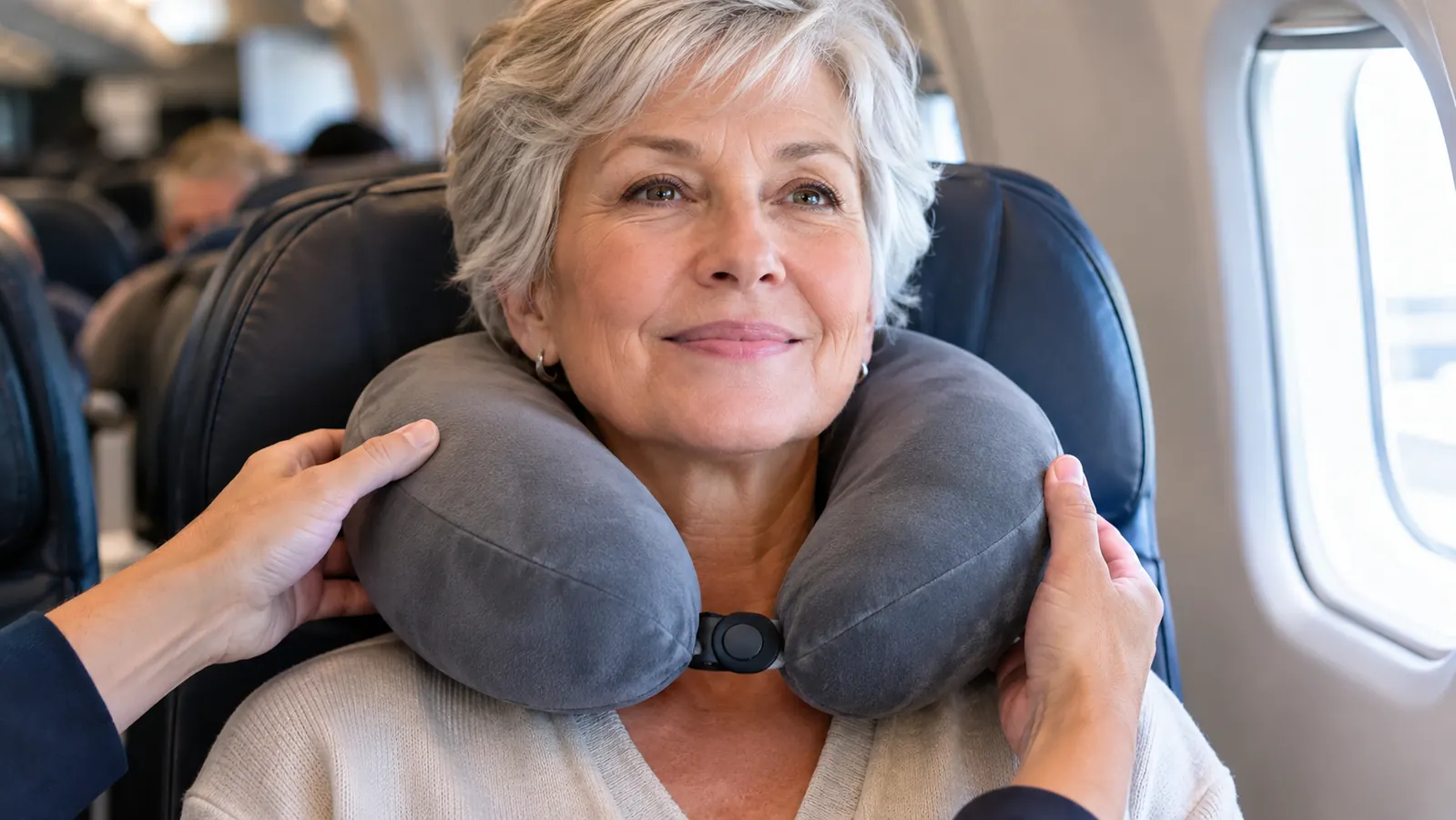
The napfun pillow wins on the thing that matters most when you are trying to sleep sitting up: support. The memory foam is firm enough to hold my head without me tensing my neck to keep it upright, but it still gives a little where my jaw meets it. On that next flight to Phoenix, I slept for well over an hour in one stretch and woke up with my head still upright and none of the usual stiffness. On the earlier flight, with the inflatable, I dozed in fifteen-minute pieces and woke every time my head tipped past the edge of it. That has been my experience with inflatables every time, not just that once.
It also wins on durability. I have been using the napfun pillow for about a year now, on several round trips and long car rides, and it still looks and feels the same as the day it arrived. The cover zips off and goes in the wash, which matters to me because I have seen what airplane headrests look like up close. I wash it on gentle after every trip and dry it over a kitchen chair. An inflatable pillow, by contrast, is always one seam away from becoming a sad plastic bag. I have had two develop slow leaks, one on a flight to Florida, where it was half flat by the time we landed, and one just sitting in my closet, which I found out about the next time I tried to use it.
The napfun pillow also does something I did not expect: it stays put. The inflatable always seemed to slide forward off the headrest, so I would wake up with it bunched under my chin and my neck bent at an angle that felt worse than no pillow at all. The memory foam holds its shape, and the clasp in front keeps the two ends together, so it does not creep. On the drive to North Carolina, I rested my head against the passenger window for about forty minutes and the pillow did not shift once. When I switched to the inflatable at the rest stop, I had to readjust it three times before the next exit.
There is a quieter win too: it is ready the moment you want it. With the inflatable, I would sit down, buckle in, dig it out, and then blow into a valve in a crowded row while the man in the aisle seat pretended not to watch. If I let some air out to soften it, I had to start over when it got too soft. With the napfun, I take it out of its bag the night before so the foam has time to fully expand, wear it through the terminal around my shoulders, and it is already on when I sit down. When the plane levels off and I start to nod, there is nothing to do. On an early flight, when I am at my most tired and least patient, that matters more than I would have guessed.
Where the Inflatable Wins
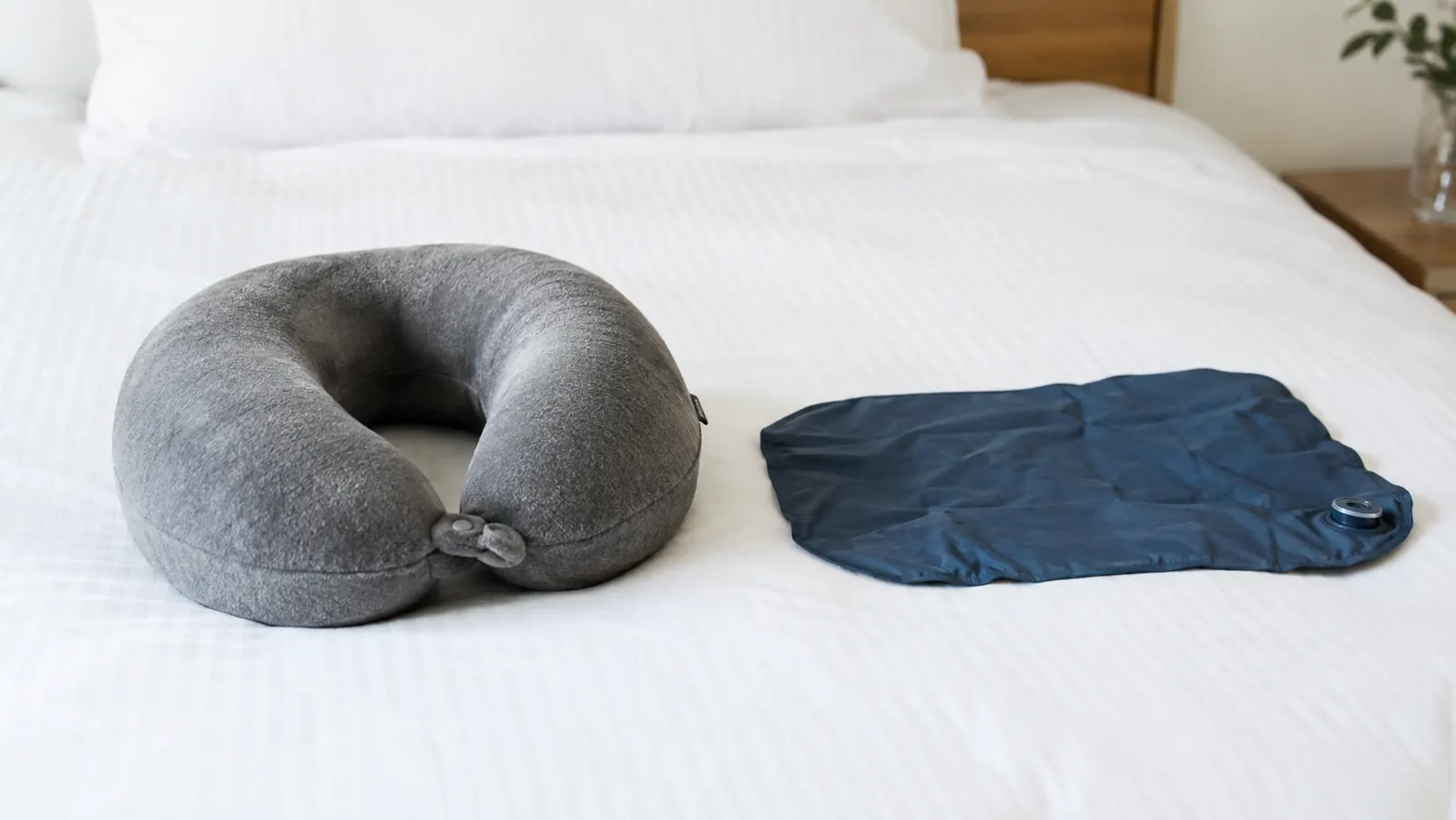
I am not going to pretend the inflatable does not have a place. It wins on packing size, and it is not close. The napfun pillow squashes into its compression bag, but even then it is about four inches thick and needs a real pocket. The inflatable rolls down to about the size of a pair of socks and disappears into any corner. On a trip where I am already overpacking, which is most of them, that difference matters. If you are traveling with only a personal item under the seat in front of you, the inflatable may be the only pillow that fits at all. It also costs less up front, which makes it an easier way to find out whether you are even a neck pillow person.
The inflatable also wins on adjustability. You can blow it up partway for a softer feel or all the way for a firmer one, and you can let a little air out mid-flight if your neck starts to complain. The napfun pillow is what it is: a fixed shape and a fixed firmness that either suits you or does not. Dale, for one, prefers soft, and he found the napfun too firm when he tried it. He ended up on a folded airline blanket against the window, and he was happy. For me the napfun works, but I understand why some travelers want to tune the firmness.
There is one more thing the inflatable has going for it, and it is the reason I kept mine even after the napfun won me over. On that first flight out to Phoenix, I used the inflatable as a lumbar pad for the first hour, partly blown up and tucked behind my lower back, which tends to complain after long sitting, then moved it up to my neck once the drink cart had come through. I could not do that with the napfun, because the memory foam is too thick and shaped to fold into a back pad. Now, on long flights, I sometimes bring both: the napfun for my neck and the deflated inflatable, which weighs almost nothing, for my back. That combination has been the most comfortable setup I have found.
And I will give the inflatable one more honest point: it runs cooler on a warm day. Memory foam holds body heat, and on the drive to North Carolina in early summer, with the sun coming through the passenger window, my neck got warm under the napfun after an hour or so. I took it off for a while and put it back on once the car cooled down. The inflatable's fabric cover never got warm the same way. On a cold plane this is no issue at all, and the napfun actually feels nice, but if you run warm or you are traveling somewhere hot, it is worth knowing.
If you want support that lasts the whole flight
The napfun memory foam pillow is the one I reach for now, and the one I wish I had worn on that first stiff flight out to Phoenix. It takes more space than an inflatable, but it does the job an inflatable could not do for me: hold my head up for hours.
Amazon Check Today's Price on Amazon →Who Should Buy Which
Buy the napfun pillow if you fly more than twice a year, if you have ever gotten off a plane unable to turn your head comfortably, or if you doze off in the car and wake up with your head against the window. It is also the better buy if you like firm pillows at home, because it feels the way it does on the first day and keeps feeling that way. Buy the inflatable if you are a once-a-year flyer, if you are trying to travel with nothing but a personal item, if you like a soft pillow, or if you are not sure you will even use a neck pillow and want to test the idea without much commitment.
If you are somewhere in between, here is the test I would use. Think about your last flight. If you slept fine and your neck felt normal the next morning, an inflatable or no pillow at all is probably plenty, and you can keep the space in your bag. If you woke up every time your head tipped, or you spent the first evening of your trip rubbing your neck, the support is the problem, and the support is what the napfun is good at. The bag space is a fair trade for that, at least it has been for me on every flight since Phoenix.
My honest advice is this: if you are reading this because you have a flight coming up and you are tired of arriving stiff and cranky, get the napfun, wear it on the couch a few evenings before you go, and give it a fair try. The pocket of space it takes is worth landing able to turn your head. If you are still not sure, buy it somewhere with a good return policy and try it on a short flight first. That is what I would tell a good friend. And if you have ongoing neck pain or an old injury, ask your doctor what kind of support suits you. A travel pillow is a comfort item, not a fix.
Pack the pillow that actually works
The napfun Neck Pillow is the one I now pack for every flight over two hours. It takes more room than an inflatable, but on every flight since Phoenix it has earned that pocket.
Amazon Check Today's Price on Amazon →