

The first time Dale and I took a cruise out of Florida, I stood at the cabin wall with my phone charger in one hand and a sinking feeling in my stomach. The only free outlet was European style, and the plug on my charger did not fit it. Not even close. The holes were round, the prongs were flat, and no amount of wiggling was going to make them match. I had packed everything else right, or so I thought, and I had completely forgotten that a ship, like most of the rest of the world, does not always use the same wall outlet we do. The EPICKA Universal Travel Adapter is the thing I reach for now, but back then I did not even know such a thing existed.
That trip, we charged our phones one at a time using the one adapter the guest services desk lent us, and we took turns sitting near the only outlet that worked. It was not a disaster, but it was a hassle we did not need. Since then, I have learned the simple system that makes it a non-issue: bring one universal travel adapter, check the voltage before you plug anything in, and charge your phone and tablet the same way you do at home. Here is exactly how to do that, step by step.
The adapter that ended my airport-panic charging problems
The EPICKA Universal Travel Adapter covers 150+ countries, lets your phone and tablet chargers handle the voltage, and gives you six ports so the whole family can charge at once. It is the one I now pack on every trip.
Amazon Check Today's Price on Amazon →Step 1: Know What You Are Plugging Into
Before you buy anything, look at the wall outlet in the country you are visiting. There are roughly a dozen plug types in the world, and the one you use at home is not the one you will find in most other countries. Europe mostly uses the two round pins you see in France, Germany, Spain and Italy. The UK and Ireland use the three rectangular pins. Australia and New Zealand use the angled flat pins. Japan and most of the Americas use the two flat pins, which is why our chargers work in Canada and Mexico without a second thought.
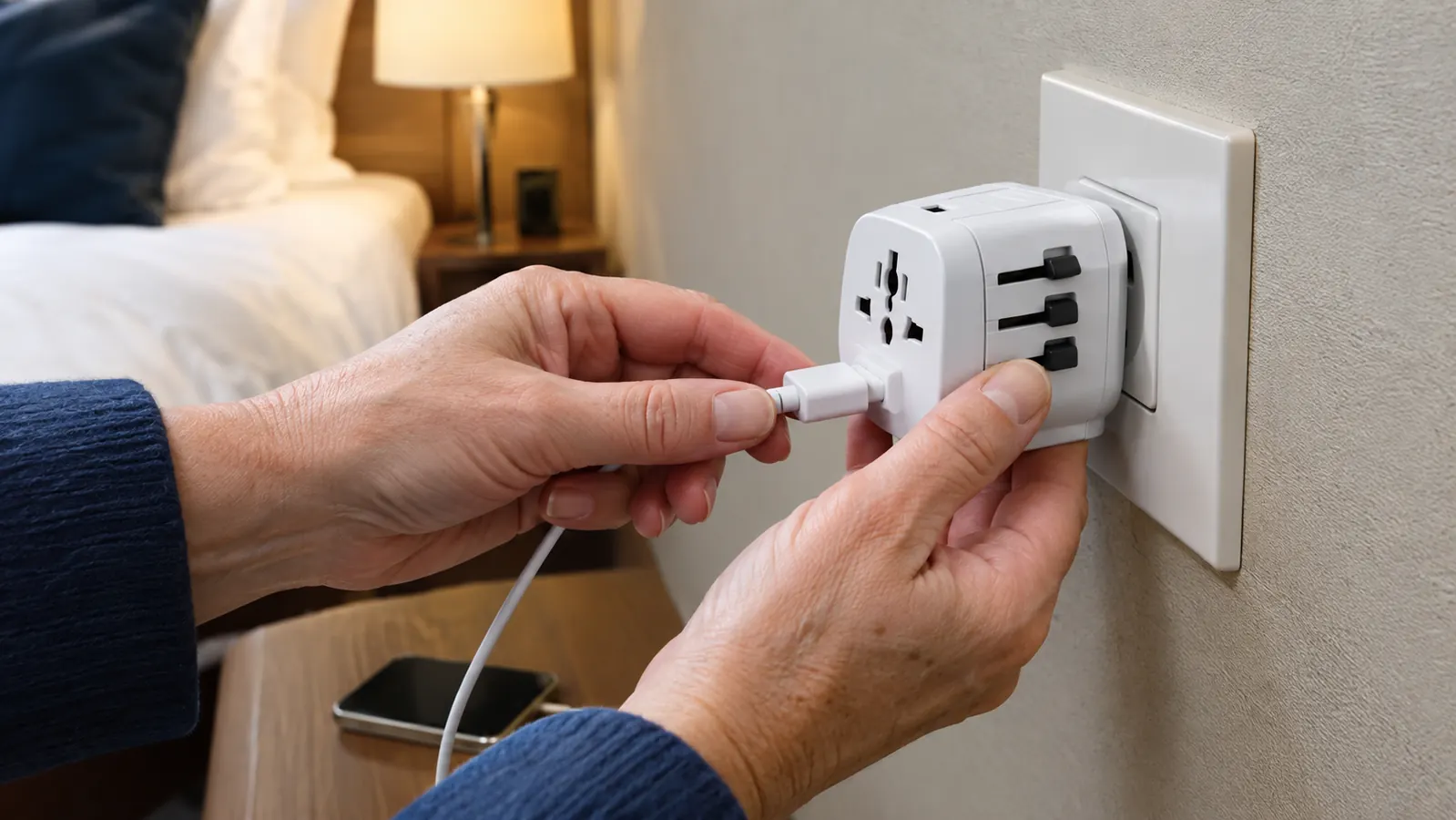
A universal travel adapter solves this by folding all the common plug shapes into one small block. You slide the right prongs out, push them into the wall, and you are done. The EPICKA adapter covers more than 150 countries, which is a fancy way of saying it has the prongs for just about everywhere regular people actually go. I have used it on our January cruise and all over Ireland, and it has fit every outlet we have met.
One thing to know before you go: an adapter only changes the shape of the plug. It does not change the electricity coming out of the wall. That is what Step 2 is about, and it is the step most people skip.
Step 2: Check the Voltage Before You Plug In
This is the part that scares people, and it is also the part that is almost always fine for phones and tablets. The United States runs on 120 volts. Most of the rest of the world runs on 220 to 240 volts. If you plug a hair dryer made only for 120 volts into a 240 volt outlet, you will smell something bad and the hair dryer will die. If you plug a phone charger into the same outlet, nothing bad happens, because phone chargers are dual voltage. Look at the little block on your charger cord and you will see it says something like 100-240V. That means it handles both.
The EPICKA adapter does not convert voltage, and it does not need to for your phone, tablet, camera or e-reader. Those all have chargers that handle 100 to 240 volts, so the adapter just changes the plug shape and lets the charger do its job. What you do need to be careful about are things like hair dryers, curling irons, electric toothbrushes and any appliance that has a motor or a heating element. Those are often single voltage, and they need a separate voltage converter, not just an adapter.
My rule is simple: if it charges a battery, the adapter is all I need. If it heats up or spins, I leave it at home or I bring a converter. That one rule has kept me from ruining a single appliance in all the years we have been traveling. I checked every charger we own before our Ireland trip, and every one of them said 100-240V on the block, so I packed the EPICKA adapter and did not give voltage another thought.
Step 3: Pick an Adapter With Enough Ports
The first adapter we owned had exactly one outlet. It worked, but it meant we could charge only one thing at a time, and in a hotel room with two phones, two tablets and a camera, that meant a lot of waiting. The EPICKA adapter has six ports: one AC outlet for something that needs a regular plug, three USB-C ports and two USB-A ports. In plain language, that means Dale and I can charge both phones, both tablets and still have a port left over for a camera or a pair of earbuds, all at the same time, from one wall outlet.
That matters more than it sounds like it does. Hotel rooms never have enough outlets, and the ones they do have are often behind the nightstand or across the room from the bed. One adapter with six ports turns a single outlet into a charging station. We plug it in when we arrive, and we do not think about outlets again until we pack up to leave. On our last trip to North Carolina to see our daughter and the grandkids, we charged two phones, a tablet and a pair of earbuds from one outlet behind the nightstand, and nobody had to wait.
The ports also handle fast charging for phones and tablets, which is the difference between topping up during breakfast and sitting around waiting for a full charge. I am not going to pretend I understand every wattage spec, but I do understand this: our phones charge overnight with no problem, and they charge quickly during the day when we need a boost before heading out. On the day we flew home from Ireland, we topped both phones up at the airport cafe in about forty minutes while we had coffee.

Step 4: Pack It Where You Can Find It
Here is the mistake I made on that first cruise: the adapter was in the bottom of my checked bag, which was fine until the bag did not reach our cabin until after dinner. Now the EPICKA adapter lives in the front pocket of my carry-on, zipped into the same pouch as my phone cables. It is small enough that it does not add weight or bulk, and it is always with me when I need it. The whole thing weighs about as much as a deck of cards, so there is no excuse for burying it in a bag I cannot reach.
Dale is the one who always forgets a charger, so I also keep a spare cable in my carry-on. The adapter itself is the part you cannot borrow from the front desk at midnight, so that is the part I never let out of my sight. If you travel with a partner, decide before you leave who is carrying the adapter, and then check that it is actually in the bag before you close the door. We do that check at the kitchen counter before we even load the car, and it has saved us more than once.
One more packing note: the EPICKA adapter has a built-in fuse and surge protection, which is a nice thing to have when you are plugging your phone into a wall outlet in a country you have never visited. It is one of those details you do not think about until you need it, and then you are glad it is there. On our Ireland trip last spring, the adapter went into a different socket almost every night for two weeks, and apart from getting a little warm with every port busy, it never gave us a moment of trouble.
Step 5: Use It the Right Way at the Wall
When you get to your hotel room, find the outlet you are going to use and push the correct prongs out of the adapter. The EPICKA adapter has a slider that lets you choose the plug type, so you do not have to guess. Slide it until the prongs match the outlet, push the adapter in, and then plug your chargers into the ports. It takes about ten seconds, and it is the same every time. The first night in Dublin, I had both phones charging before Dale had even found the light switch.
A few things I have learned the hard way: do not force the adapter into an outlet if the prongs do not match, because you have the wrong plug type selected. Do not plug the adapter into a power strip that is already overloaded. And do not leave it in the wall when you check out, because that is how you end up buying a second one at the airport gift shop. I have done that, and I do not recommend it. The replacement I bought at the airport only had two ports, and I missed the EPICKA one the whole rest of that trip.
When you are ready to leave, unplug everything, slide the prongs back in, and put the adapter back in the front pocket of your carry-on. If you do that every single time, you will never stand in a hotel room at midnight wondering why your phone will not charge. It takes less than a minute, and it means the adapter is ready for the next trip instead of sitting in a drawer somewhere.
What Else Helps
A universal travel adapter is the main thing, but a few small additions make the whole system work better. A short extension cord with a standard plug gives you more reach when the only outlet is behind the bed. A multi-port USB charger is handy if you are staying somewhere with a desk outlet that is easy to reach. And a small cable organizer keeps the tangle of cords from taking over your carry-on. None of these are required, but they all make the difference between a charging setup that works and one that feels like a puzzle.
The other thing that helps is a little bit of planning before you leave. Look up the plug type for the country you are visiting, check that your chargers are dual voltage, and make sure the adapter is in your carry-on, not your checked bag. Ten minutes of planning saves you from the exact problem I had on that first cruise, and it costs nothing. I keep a small note in my phone with the plug type and voltage for wherever we are headed, and I check it while we are waiting at the gate.
One adapter with six ports turned a single hotel outlet into a charging station for both of us, and we have not thought about wall outlets on a trip since.
Start your next trip with the right plug
The EPICKA Universal Travel Adapter is the one I pack in the front pocket of my carry-on every time we fly. It covers 150+ countries, lets your phone and tablet chargers handle the voltage, and gives you six ports so nobody has to wait their turn to charge.
Amazon Check Today's Price on Amazon →